
Engineered Septic Systems in Teller County: What They Cost in 2026 and What's Changing


Engineered septic systems in Teller County typically run $32,000–$35,000+ in 2026. Here's exactly where the money goes, and what's changing under new regulations.
If you're building or buying property in Teller County, you've probably already heard that septic out here is expensive. The honest answer is yes, it usually is, and there are real reasons for it. A standard engineered septic system for a 2–3 bedroom home in our area runs between $32,000 and $35,000 in 2026. That number surprises people, and it should be explained, not glossed over.
At Peak DirtWorks, we install engineered systems regularly across Florissant, Divide, Woodland Park, Cripple Creek, Lake George, and the broader Teller and Park County mountain communities. We do the soil work, set the tanks, build the sand filter, run the pressure-dosed laterals, and coordinate with the engineer and the local health department through final inspection. We see the cost breakdown from the inside, and the goal of this post is to show you the same view.
We're also going to cover the regulatory update Teller County is rolling out. The state amended Regulation 43 in 2025, and Teller County is in the process of formally adopting it locally, with full implementation required by June 15, 2026 and likely happening sooner. If you're planning a build, a property purchase, or a system replacement, the timing matters.
What this post covers
- 2026 cost ranges for engineered septic systems in Teller County
- Why our soils almost always require an engineered system
- The concrete vs. plastic tank decision, and what it costs
- Why the sand filter is the single biggest cost driver
- How Peak DirtWorks installs to spec using laser-grade equipment
- The Teller County regulatory changes coming in 2026
- FAQ for buyers, builders, and property owners
How much does an engineered septic system cost in Teller County in 2026?
A standard engineered septic system for a 2–3 bedroom home in Teller County costs between $32,000 and $35,000+ in 2026. A non-engineered standard system, when soils allow one, runs between $18,000 and $22,000. Most properties in our area cannot use a non-engineered system because of soil and bedrock conditions.
That price covers the full turnkey install: soil test excavation, septic tank, pump tank (when required), sand filter, infiltrators, geofabric, Schedule 40 PVC, fittings, distribution components, electrical for the pump, excavation, backfill, final grading, and coordination with the engineer and Teller County Public Health & Environment through inspections. It does not cover the engineer's design fee, which is a separate cost paid directly to the engineering firm.
Difficult access, deep frost considerations, long runs to the soil treatment area, and rock encountered during excavation can push the number higher. A clean site with good access on the lower end of the range, a tougher site on the upper end or beyond.
Why do our soils usually require an engineered system?
Most of Teller and Park County sits on decomposed granite, with shallow bedrock common across the mountain communities we serve. Decomposed granite percolates too fast in some places and not at all in others, and it rarely meets the long-term acceptance rate that Colorado Regulation 43 requires for a standard gravity-fed system. The result is that engineered systems with higher-level treatment, almost always involving a sand filter and pressure dosing, become the default rather than the exception.
In our experience walking sites across Florissant and Divide, we can usually tell within the first few minutes of looking at the topography and exposed soil whether a property is going to need an engineered system. The official answer always comes from soil profile pits and percolation testing by a competent technician, and we coordinate that work on every project. But the practical reality is that we plan for engineered as the baseline in this area, and we're rarely wrong.
This is also why pricing comparisons against other parts of Colorado, or against national cost-estimator websites, don't apply here. A $12,000 standard septic install on the Front Range is a different product than what your property actually requires.
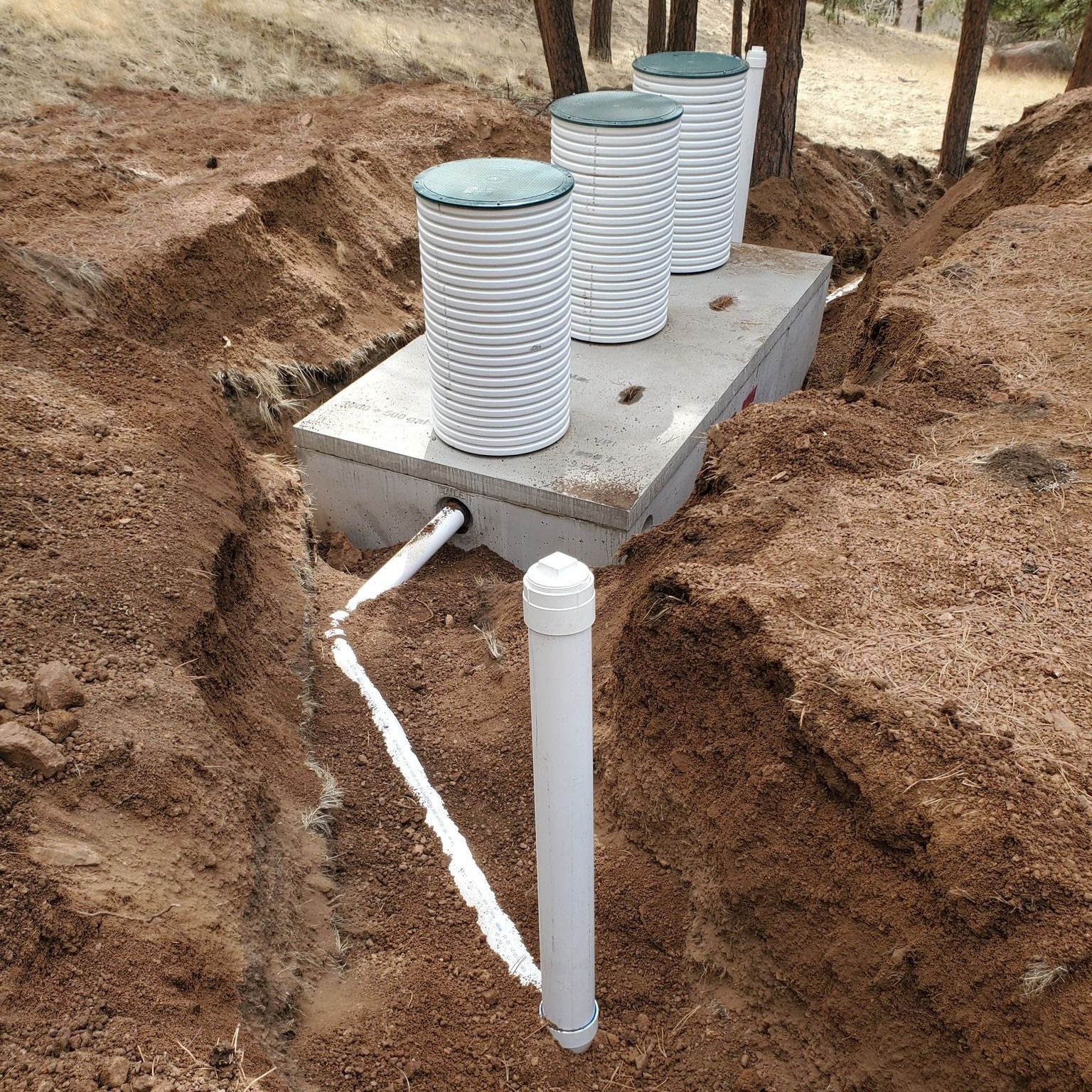
Concrete vs. plastic septic tanks: which is right for your site?
The right tank depends primarily on site access. Concrete is the default when the install location is reachable by a heavy crane truck, because a single concrete tank can hold both the main and pump compartments and minimize the footprint. Plastic becomes the better choice when access is limited, because plastic tanks can be set with smaller equipment, but plastic requires a separate main tank AND a separate pump tank rather than a single combined unit. Each plastic tank requires access to water or a water delivery to partially fill the tank to keep it in place during backfill.
Here's what that looks like in cost terms:
Tank type: Configuration: Starting cost (tank + risers):
Plastic Single 2-compartment, no pump tank ~$2,000
Plastic Main tank + separate pump tank ~$3,000+
Concrete Combined main/pump (single unit) varies by size
"We make the concrete-vs-plastic call based on what the site can actually accept. Plastic gives us flexibility on tight or remote properties where we can't get a tank truck close to the install. Concrete is more traditional, generally more durable in the long run, and it lets us combine the main and pump function in one unit. Neither is automatically right or wrong, the site tells us which one fits."
— Troy Loftus, Owner, Peak DirtWorks
It's worth noting that the tank is rarely the biggest line item on an engineered system invoice. The sand filter is.
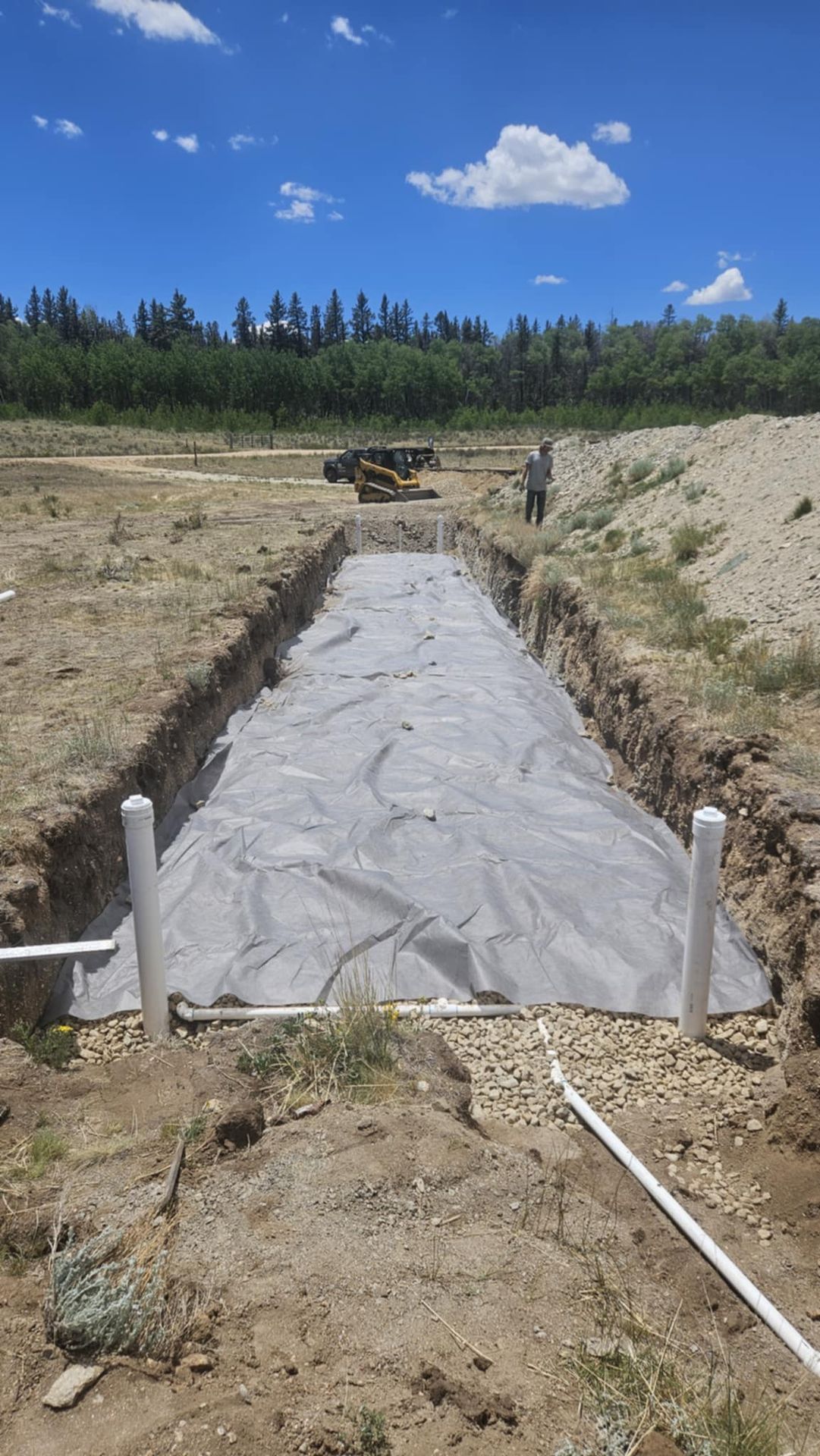
Why does an Engineered Septic System so much to the cost?
The sand filter is the single largest cost driver on a typical Teller County engineered system, and the reason is straightforward: sand is in limited supply, the trucks that haul it are expensive, and most engineered designs in our area call for a 3-foot sand filter, which means a significant volume of imported material delivered to a mountain property and spread with equipment.
The sand itself runs about $45 per ton. A 3-foot sand filter for a typical 2–3 bedroom engineered system requires truck loads of properly graded sand, and most of that sand comes from the same regional supplier. The cost driver isn't really the sand, it's the trucking. Mountain properties, long driveways, and remote access multiply the haul cost.
That's before we add infiltrators, geofabric, Schedule 40 PVC pipe, fittings, distribution boxes, valves, electrical for the pump, and all the other components that go into a code-compliant install. Materials alone, before the sand, can exceed $10,000 on a standard engineered system. Once you add the sand, the labor, the equipment time, and the coordination with the engineer and the health department for inspections, the $32,000–$35,000 range starts to make sense.
This is also why corner-cutting on an engineered install is so dangerous to a homeowner. The sand filter has to be level. Pressure dosing has to be uniform across the laterals, which is verified by a squirt-height test at final inspection per Regulation 43. A system installed by someone who's eyeballing grade with a string line is a system that will fail inspection, fail prematurely, or both.
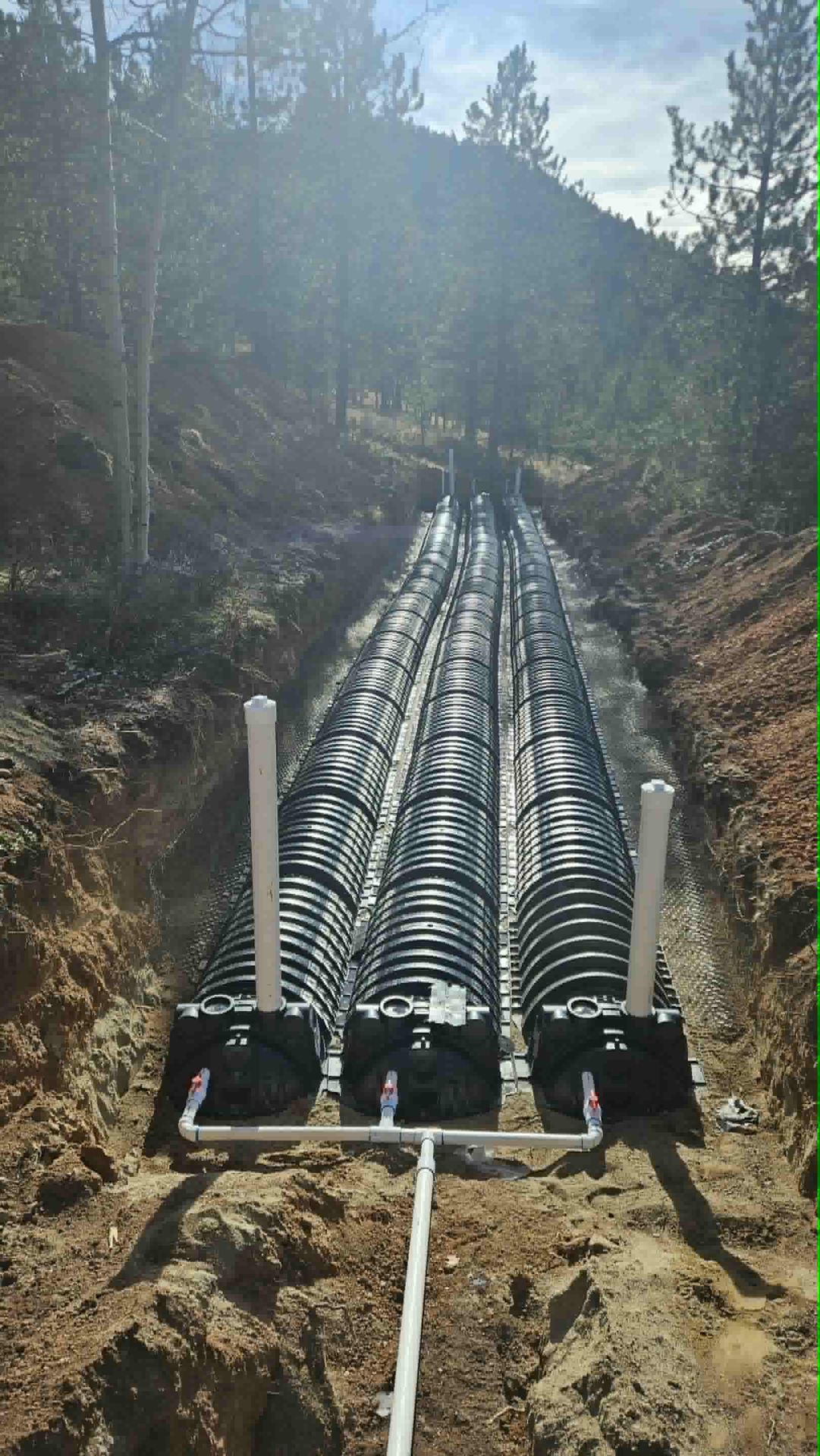
How Peak DirtWorks installs to spec
We use state-of-the-art equipment to install engineered septic systems precisely to the engineered design, not to where the dirt feels close enough. The most important piece of that, on a sand filter install, is laser-grade verification at every stage: bottom of the filter excavation, top of the sand layer, lateral elevations, and final cover.
"Installing an engineered septic isn't a job where 'close enough' works. The sand filter has to be installed pefectly level, the laterals have to dose evenly, and the final grade had to direct drainage away from the leach field. We use laser equipment at every grade-critical step because that's how the system ends up performing the way it was designed to perform, for the full life of the system."
— Casey Loftus, Owner/Manager & Estimator, Peak DirtWorks
We also coordinate every job directly with the engineer of record and with Teller or Park County Public Health & Environment.
What's changing with OWTS Regulations in Teller County in 2026?
Colorado amended Regulation 43, the state OWTS regulation, in March 2025, with the state-level changes effective June 15, 2025. Teller County is in the process of adopting the updated regulation locally, and the local implementation deadline is June 15, 2026. Public comment was held in May 2026, and Teller County Environmental Health has indicated they intend to implement before the June 2026 deadline.
A few of the most important changes for property owners to know about:
Transfer-of-Title (ToT) inspections will be required. Teller County is formally adopting a Transfer-of-Title program. That means before a property with a septic system is sold or transferred, the system must be inspected by a NAWT-certified inspector registered with the Teller County Building Department to demonstrate it is functioning as designed. There are specific exemptions (spousal transfers, foreclosures, court orders, properties being demolished, certain inheritances), but most ordinary real estate transactions will trigger this requirement. The inspection report must include septic tank, mechanical components, and the soil treatment area, each within the previous 12 months.
An Operation and Maintenance (O&M) program is being adopted. Higher-level treatment systems (which includes most engineered systems with sand filters) will fall under formal ongoing maintenance and oversight requirements. This isn't optional inspection, it's a structured program.
Title Continuance Use Permits within 60 days of closing. After a property transfer, the new owner has 60 days to apply for a Title Continuance Use Permit, which transfers the septic permit into the new owner's name. Miss the window and the permit becomes invalid, with penalties.
Mandatory licensing of system contractors, cleaners, maintenance providers, and ToT inspectors. Teller County is requiring formal licensing of everyone working on an OWTS, not just installers. This is a positive change for property owners because it raises the floor on who can legally touch your system.
Soil test verification is stricter. Teller County will not accept a percolation test alone without a soil profile pit evaluation performed by a competent technician. Previous soils data from prior site work may need to be re-verified before a new permit is issued.
If you're planning a build, a property purchase, or a system replacement in 2026, the timing of when your permit is pulled relative to the local adoption date will determine which version of the rules your system has to meet. Systems permitted under the current regulation will be held to current standards. Systems permitted after adoption must meet the new ones.
You can review the draft regulation directly on the Teller County Environmental Health page.
What can go wrong when hiring a Septic Installation Contractor and what to look out for
A few honest things to watch for, whether you're hiring us or evaluating any other contractor:
Mid-grade equipment grading a sand filter by feel.
If a contractor isn't using laser-level verification at every grade-critical step, the sand filter will not be flat, the pressure distribution will not be uniform, and the squirt-height test at final inspection will catch it.
A bid that's a lot lower than the others.
On an engineered system, a $10,000 or $15,000 spread between bids usually means someone is leaving something out, undersizing a component, or planning to use the wrong material. Ask what's included before you compare numbers.
No coordination with the engineer.
The engineer of record certifies the install per Regulation 43. A contractor who isn't talking directly to the engineer through the build is a contractor who's guessing.
Vague or missing record drawings at final.
The county requires a scale record drawing showing all components with dimensions, depths, and locations from findable points. That document is what protects you for the life of the system. Most Engineers include this service, while some Contractor's do their own As-Built Drawings. It is important to confirm who's responsibility to ensure the system is being mapped prior to backfill, and so that the County will receive the final As-Built drawings in order to close our the permit.
FAQ
How long does an engineered septic install take?
A typical engineered system install runs about 5-7 business days of active work on site once we've started, weather and inspection scheduling permitting. The full project timeline can vary based on how long it takes to obtain a permit, scheduling with suppliers for delivery, and coordinating with Engineer and local permitting agency for inspections.
Do I need an engineered system on my property in Teller or Park County?
Not every property, but most. The deciding factor is soil and site evaluation, not a default rule. We've installed standard systems where soils allowed, but the majority of properties in our service area require engineered systems because of decomposed granite, which perks too quickly, or shallow bedrock which requires additional material to be brought it to allow for proper treatment of the effluent.
Can I install my own septic system in Teller County?
A Homeowner can install their own system, provided they have passed the Septic Installer Test and obtained a license from the Building Department. OWTS installation requires a licensed systems contractor under both state Regulation 43 and Teller County regulations, and that licensing is being formalized further under the 2026 update. Permits will not be issued for self-installation of engineered systems by non-licensed individuals.
What's the engineer's fee, and is it included in your estimate?
The engineer's design fee is paid directly to the engineering firm and is not included in our estimate. Engineered design fees typically run a few thousand dollars depending on site complexity. We coordinate with whichever engineer you choose, or we can recommend firms we work with regularly.
Does Peak DirtWorks do septic pumping?
No, we do not provide septic pumping services. We install, repair, and replace systems. Pumping is handled by licensed pumping providers, and we're happy to coordinate or refer.
What happens if I'm buying a property right when the new Teller County regulation takes effect?
Talk to your real estate agent and to the seller about a recent inspection. Under the 2026 update, a Transfer-of-Title inspection will be required for most sales, and the new owner will need to apply for a Title Continuance Use Permit within 60 days of closing. Getting ahead of both is the right move.
What's the most important question to ask a septic contractor?
If they are experienced in our area to install systems. Teller and Park Counties have very different terrain and soils than Colorado Springs or other areas in Colorado. We highly recommend choosing a local Contractor from the area- someone with verifiable experiece installing systems in this area.
The bottom line
Engineered septic systems are expensive in Teller and Park County Colorado because the soils require them, the components cost what they cost from Rural suppliers, and the installation has to be done precisely or the system will fail. A range of $32,000–$35,000 for a standard 2–3 bedroom engineered system is what an honest, code-compliant install costs in our area in 2026. Anything dramatically lower is leaving something out. Anything dramatically higher should come with a clear reason tied to site difficulty, such as the need for blasting, larger leach field, etc.
With the Teller County regulation update coming in 2026, the timing of your permit, the licensing of your contractor, and the quality of the install matter more than ever. We're here to help you think through the decision, whether you end up hiring us or not.
Planning a build, a system replacement, or a property purchase in Teller or Park County? How can Peak DirtWorks help?
Call 719-445-PEAK to set up a free site evaluation, or visit www.peakdirtworks.com to learn more about our septic installation services. We serve Florissant, Divide, Woodland Park, Cripple Creek, Lake George, Hartsel, and the surrounding Teller and Park County mountain communities.
Voted Best of Teller 5 Years Running.
Written by Casey Loftus, Owner/Manager, Peak DirtWorks LLC. Casey runs site evaluations, estimates, and project coordination for Peak DirtWorks, a Florissant-based excavation, concrete, septic, and demolition contractor serving Teller and Park County. Peak DirtWorks is fully licensed, bonded, and insured in Teller County, Park County, and the City of Woodland Park, and works regularly with local engineers and Teller County Public Health & Environment on engineered septic system installations.